


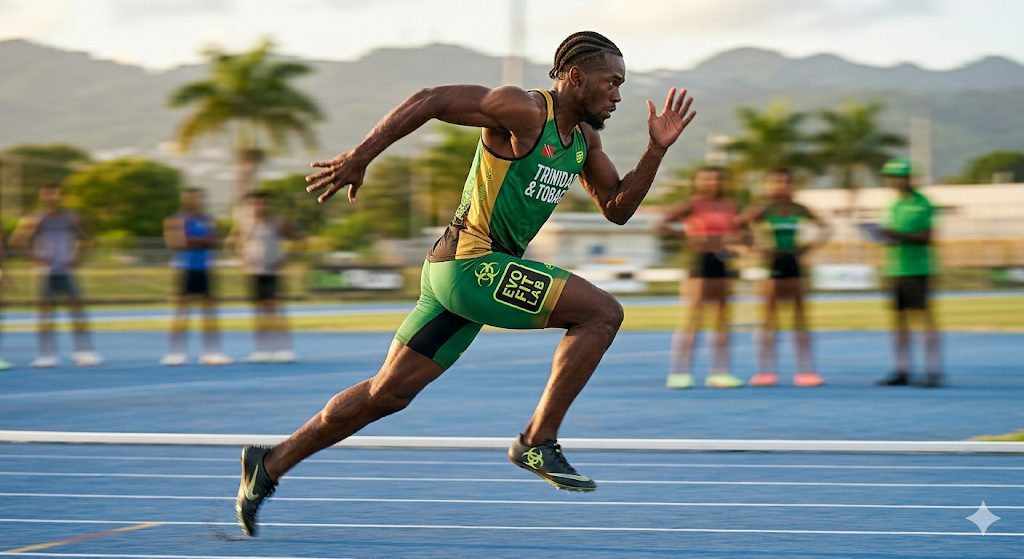
Many athletes believe performance drops after 70 meters because of conditioning. However, the real reason is often far more specific. In most cases, the athlete is not truly exhausted metabolically. Instead, coordination begins to fail at very high speed.
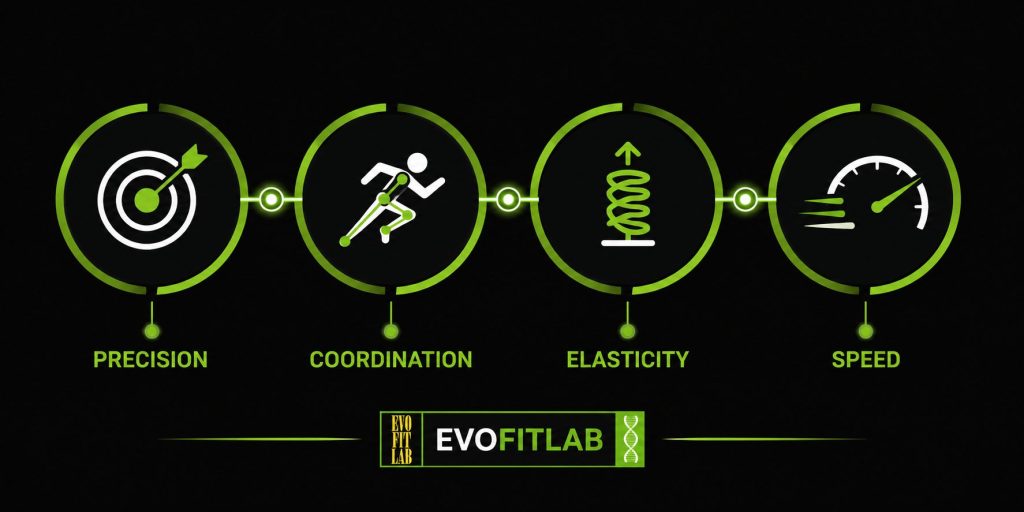
Speed Endurance Training for Athletes is not simply about lasting longer. It is about maintaining precision, rhythm, posture, and elasticity while moving near maximal velocity.
At EvoFitLab, we view speed endurance as neuromuscular coordination endurance under extreme movement demand.
Why athletes slow down after 70 meters
As sprint velocity increases, nervous system demand rises sharply. Arms and legs cycle faster, ground contacts shorten, and the margin for error becomes extremely small.
At slower speeds, coordination is relatively easy. Once athletes approach top velocity, small technical errors become magnified.
Common breakdowns include:
- Slight overstriding
- Poor front-side mechanics
- Delayed arm timing
- Loss of stiffness and elastic return
These issues are often blamed on conditioning. In reality, they are frequently coordination failures under high-speed conditions.
For movement preparation before sprint sessions, use our Four Worlds Movement Framework.
Redefining speed endurance
Traditional thinking asks:
“How long can the athlete last?”
At EvoFitLab, we ask:
“How long can the athlete maintain clean mechanics at maximal speed?”
This distinction changes programming completely.
Speed endurance is:
- Precision under speed
- Coordination under stress
- Mechanics under time pressure
As a result, training should challenge technical consistency, not just conditioning volume.
The 3-second rule in sprint training
One of the most important concepts in maximal velocity training is the 3-second threshold.
| Sprint Exposure | Training Goal |
|---|---|
| Under 3 seconds at max velocity | Speed development |
| Over 3 seconds at max velocity | Speed endurance development |
Why does this matter?
After roughly 3 seconds near maximal velocity, maintaining coordination becomes increasingly difficult. Therefore, this is where athletes begin to lose posture, rhythm, and elastic efficiency.
This is also where intelligent speed endurance training creates adaptation.
For athletes transitioning into advanced power work, layer principles from our Rate of Force Development Training.
How EvoFitLab trains speed endurance
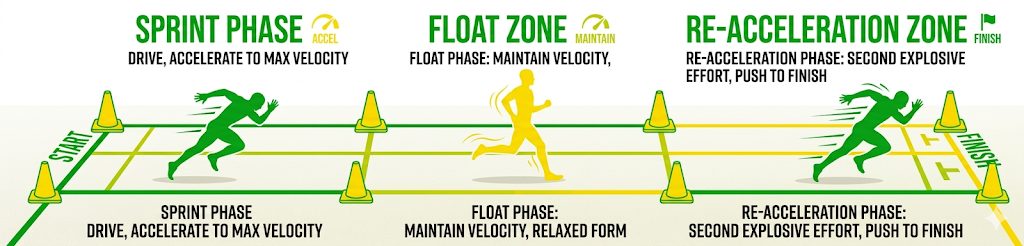
At EvoFitLab, Sprint–Float–Sprint (SFS) progressions are a key tool for developing high-speed coordination.
For speed development
- Short max-velocity zones
- Less than 3 seconds exposure
- Relaxed mechanics emphasized
- Full recovery between reps
For speed endurance
- Extended max-velocity exposure
- 3 to 4.5+ seconds near top speed
- Wider cone spacing
- Increased technical demand
This forces athletes to:
- Maintain posture
- Control limb timing
- Preserve stiffness and elastic return
- Resist coordination breakdown
Internal link: Structure yearly sprint progression intelligently with our Fitness Periodization Guide.
Why this matters beyond sprinting
This concept is not limited to track athletes.
In football, basketball, rugby, and court sports, late-game movement quality often declines before true metabolic exhaustion occurs.
Coaches commonly observe:
- Slower acceleration
- Poor decision-making
- Inefficient cutting mechanics
- Reduced sprint posture
In many cases, this reflects high-speed coordination breakdown rather than poor fitness.
Consequently, athletes who maintain coordination under speed often:
- Stay efficient later into games
- Reduce injury risk
- Maintain better tactical execution under pressure
Injury prevention and physiotherapy perspective
When coordination deteriorates at high speed:
- Ground contact mechanics change
- Load distribution shifts
- Tissue stress increases
This is frequently when hamstring, groin, calf, and hip injuries occur.
The issue is not always fatigue itself. Instead, injury risk rises when athletes lose control of high-speed movement.
Research from the British Journal of Sports Medicine and PubMed consistently highlights sprint mechanics and neuromuscular efficiency as major contributors to injury reduction in high-speed sports:
Nutrition and recovery considerations
Although coordination is the primary limiter, recovery quality still affects nervous system performance.
Key support strategies include:
- Adequate carbohydrate intake
- Proper hydration
- Sodium, potassium, and magnesium balance
- Consistent high-quality sleep
Poor recovery reduces neuromuscular firing quality and decreases coordination capacity under speed.
The International Olympic Committee consensus statements also reinforce the importance of fueling and recovery in repeated high-intensity sport:
https://www.olympics.com/ioc

Coaching checklist for speed endurance sessions
Before training
- Athlete adequately hydrated
- Sprint volume planned
- Full warm-up completed
During training
- Monitor posture and rhythm
- Prioritize quality over volume
- Use full recovery intervals
After training
- Assess sprint mechanics under fatigue
- Begin recovery nutrition quickly
- Review video for coordination breakdowns
Conclusion
Speed Endurance Training for Athletes is not simply conditioning. Instead, it is the ability to sustain coordination and mechanics while moving at maximal velocity.
The athlete who maintains posture, rhythm, elasticity, and precision at the highest speeds for the longest time usually wins.
Train speed with intent. Train coordination under stress. Build athletes who can execute when velocity is highest.
Written by Gerard Nicholas, CSCS