

Interval training is one of the most powerful tools in sports performance, but it is also one of the most widely misunderstood. Many athletes equate the intensity of a workout with its effectiveness. They run faster, push harder, and finish completely exhausted, operating under the assumption that more pain equals more progress. If your goal is to build genuine aerobic power, your training must be guided by physiology rather than emotion. Understanding the mechanics of VO2 max training for athletes is the absolute key to unlocking elite endurance.
Understanding the Physiology of Oxygen Uptake
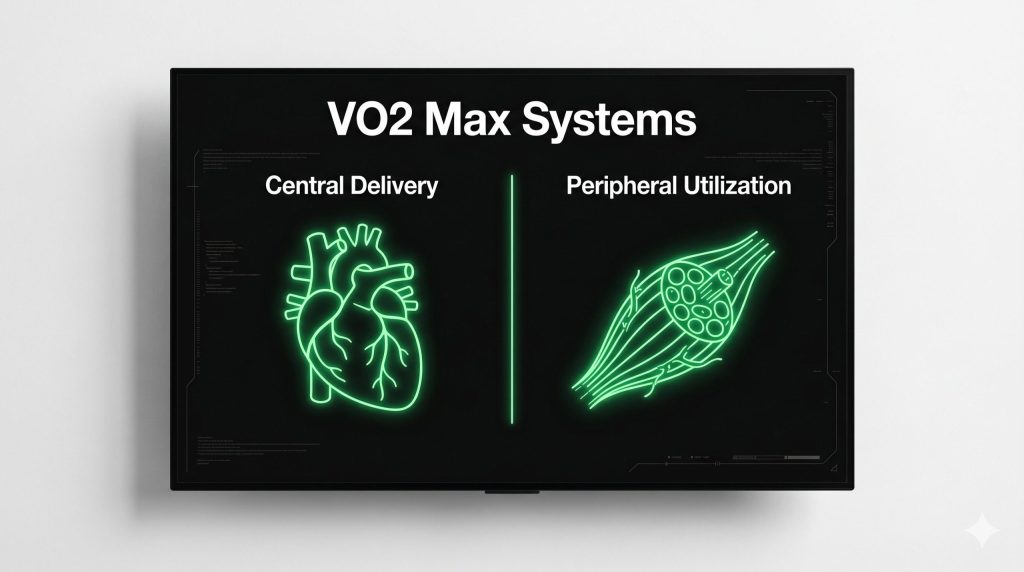
VO2 max is defined as the maximum rate at which your body can take in, transport, and utilize oxygen per minute. It is not just a single physical trait. It is the integration of multiple biological systems working together perfectly. According to the American College of Sports Medicine (ACSM), building this capacity requires stressing the body across two main categories.
First, you have the central delivery components. This involves your heart stroke volume, your blood plasma volume, and your vascular system. These factors determine how much oxygen can be transported to the working muscles. Second, you have the peripheral utilization system. This involves muscle fiber mitochondrial density and oxidative enzyme activity. The peripheral system dictates how efficiently your muscles can actually use the oxygen that has been delivered. Improving your performance requires targeted stress on both systems.
The Problem with Short Intervals
The primary goal of VO2 max training for athletes is to maximize the amount of time your body spends at or very near its maximal oxygen uptake. This is where most traditional interval workouts fail. Your body does not reach its maximum oxygen uptake instantly.
Due to a concept known as oxygen kinetics, it takes roughly 60 to 90 seconds of hard effort for your cardiovascular system to reach VO2 max. If you run 30-second maximal sprints and then stop to rest, you are training your anaerobic energy systems. You are not effectively training your aerobic power because you stop right before your oxygen uptake peaks. To explore how we build comprehensive energy system protocols, review our athletic development services.
How to Structure Effective Interval Sessions

To spend meaningful time at your maximum oxygen capacity, your intervals must be long enough to overcome the oxygen kinetics delay. The National Strength and Conditioning Association (NSCA) highlights that intervals lasting between 3 to 5 minutes are optimal for this specific adaptation.
Instead of running until you collapse, try a structured approach:
- Perform 5 intervals lasting 4 to 5 minutes each at your target VO2 max pace.
- Take 2 to 3 minutes of easy active recovery (like a light jog) between sets.
- Focus heavily on consistent pacing and controlled breathing across all intervals.
A session structured this way allows you to accumulate 15 to 20 total minutes precisely in the zone that forces physiological adaptation.
Injury Prevention Under Fatigue
From a clinical physiotherapy perspective, poor interval execution dramatically increases injury risk. When athletes perform chaotic, poorly paced intervals, their mechanics break down as fatigue sets in rapidly. This mechanical breakdown leads to stride irregularities and excessive joint loading.
Clinical data published in PubMed consistently shows that hamstring strains and Achilles tendon overloads are highly correlated with running under extreme, unmanaged fatigue. Maintaining a consistent pace means maintaining consistent mechanics. This predictability drastically reduces your injury risk. For athletes managing current lower limb issues, our EvoFitLab blog provides deeper insights into specific rehabilitation strategies.
Nutritional Support for Aerobic Adaptations
You cannot maximize your aerobic potential without the right structural support. Effective VO2 max training for athletes places an immense demand on your metabolic reserves. Before a session, you must ensure adequate carbohydrate availability to fuel the high-intensity effort.
Following the workout, immediate glycogen replenishment and protein intake are necessary for tissue repair. On a chronic level, athletes must monitor their iron levels. Iron is a critical component of hemoglobin, which transports oxygen through the blood. Deficiencies here will severely limit your cardiovascular potential regardless of how hard you train.
Conclusion
If your interval session leaves you destroyed but your pacing was completely inconsistent, you missed the physiological point of the workout. The goal is not to suffer blindly. The goal is to adapt intelligently. Train at the precise intensity required, maintain your mechanics, and accumulate time where it truly matters.
Ready to stop guessing and start training with precision? Book a consult with our sports science team at EvoFitLab today.
Written by Gerard Nicholas, CSCS