


At EvoFitLab, we consistently hear athletes and coaches across Trinidad and Tobago express a common frustration. They say that after 70 meters, fatigue simply kicks in and ruins their race. This late-race deceleration is almost always blamed on a lack of cardiovascular fitness. However, challenging that traditional idea is essential for true athletic development. At the 70-meter mark of a sprint, your aerobic system is not limiting you. Your anaerobic system is still actively delivering energy, and mentally, you are still highly engaged. So why does performance abruptly drop? The answer completely redefines how we approach speed endurance in sprinting.
The Real Cause: Coordination Breakdown at High Speed

To understand this performance drop, we must recognize that speed is not just a measure of physical power. It is an expression of absolute precision under velocity. As sprinting velocity increases, the demand placed on your central nervous system multiplies. Your arms and legs must cycle at extremely high frequencies, which leaves an incredibly small margin for physical error.
When you move at sub-maximal speeds, coordination is relatively easy. When you push toward absolute top speed, neuromuscular errors begin to surface. These small technical breakdowns manifest as slight overstriding, poor front-side mechanics, a loss of tissue stiffness, and delayed arm timing. These are not metabolic fatigue issues. They are neuromuscular coordination failures under high-speed conditions.
Redefining Speed Endurance in Sprinting
If the problem is coordination rather than conditioning, we must completely shift how we train. True speed endurance in sprinting is about your capacity to sustain precise coordination at maximal velocity. Instead of asking how many meters an athlete can physically survive, coaches need to ask how long an athlete can execute perfect mechanics at top speed.
There is a critical biological window in sprint training known as the 3-second rule. Sprinting at maximum velocity for under three seconds builds raw top-end speed. Sprinting at that exact same velocity for longer than three seconds forces the nervous system to maintain coordination as neuromuscular fatigue accumulates. Training in this specific zone is how we build elite resilience. You can explore how we structure these specialized loads within our athletic development services.
The Injury Prevention Perspective

When coordination fails at high speed, the physical consequences extend far beyond losing a race. As your sprint mechanics break down, your foot strike becomes inefficient. This increases your ground contact time and drastically alters how force is distributed across your joints.
This sudden increase in abnormal tissue stress is exactly when non-contact injuries happen. Clinical data from the British Journal of Sports Medicine (BJSM) frequently connects severe hamstring and groin strains to mechanical breakdown during high-speed running. You do not tear a muscle simply because you are tired. You suffer an injury because you can no longer control the violent forces of high-speed movement. For more insights on mitigating these risks, our EvoFitLab blog provides extensive resources on sports rehabilitation.
Nutritional Support for the Nervous System
While mechanical coordination is the primary limiting factor, physiological fueling still plays a massive role in maintaining your top gear. Central nervous system fatigue is heavily influenced by your hydration and systemic glycogen status.
Especially in the Caribbean heat, electrolyte imbalances involving magnesium, sodium, and potassium will directly impair neuromuscular firing. According to the National Strength and Conditioning Association (NSCA), poor systemic recovery reduces your overall coordination capacity. You must support your high-speed training with adequate carbohydrates and high-quality sleep to ensure your brain can communicate effectively with your muscles.
Conclusion
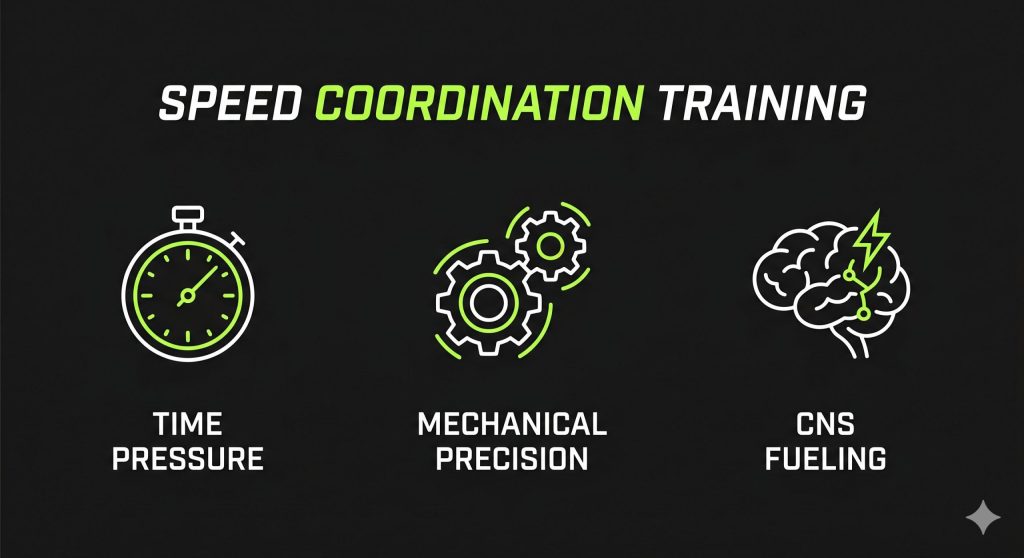
If you want to stop fading before the finish line, you must stop treating sprints like a standard endurance test. Mastering speed endurance in sprinting requires training your precision under speed, your coordination under stress, and your mechanics under extreme time pressure. Ultimately, the athlete who can coordinate their body at the highest speed for the longest time will always win.
Ready to rebuild your sprint mechanics and unlock your true late-race potential? Book a consult with Gerard Nicholas and the EvoFitLab team today.
Written by Gerard Nicholas, CSCS