

Most coaches still treat pre-game jitters like a simple emotional issue. You will frequently hear well-meaning advice like “just relax” or “calm down” shouted from the sidelines. However, modern neuroscience is telling us something very different and far more useful for athletic development. Pre-performance anxiety in athletes is not just a feeling of butterflies in the stomach. It is actually a specific brain network misfiring at the wrong time. Once you understand the physiological mechanism behind this, your entire approach to athlete preparation changes.
The Neuroscience of Sports Nerves
To manage pre-performance anxiety in athletes, we must look at what happens inside the brain. Research from Marcus Raichle’s lab, heavily cited in PubMed functional MRI studies, shows that these anxious states are driven by the Default Mode Network (DMN).
This specific neural network becomes highly active when individuals are overthinking the future, worrying about mistakes, or stuck in loops of self-doubt. In other words, the athlete’s brain becomes internally focused precisely when it should be externally ready. Elite performance requires automatic reaction, precise timing, and external spatial awareness. All of these physical traits are severely disrupted when the DMN takes over and dominates an athlete’s focus.
How Internal Focus Ruins External Execution
As strength coaches and physiotherapists, we spend significant time optimizing movement quality, load management, and physical recovery. But if an athlete is stuck in the wrong neural state, none of that physical preparation expresses itself properly on the field or court.
When the brain shifts into a protective, internally focused state, it causes tangible physical changes. Those tight hamstrings before a major competition might actually be neural tension rather than true muscular tightness. Poor decision-making under pressure is often the result of cognitive overload. By utilizing our movement screening and correctives protocols, we often identify athletes whose physical stiffness is directly tied to their pre-game mental state.
Three Brain-Based Strategies to Shift Focus
Instead of telling an athlete to relax, which often increases the activity of the Default Mode Network, coaches should actively pull the athlete’s attention outward. Here are three effective interventions to manage pre-performance anxiety in athletes:
- Task Activation: Give the athlete a specific visual or physical task rather than a thought. Telling them to “track the spin of the ball” or “hit the same target five times” pulls their attention completely out of internal anxiety loops.
- Controlled Breathing: Implement a specific breathing protocol. Inhaling for four seconds and exhaling for six seconds helps downregulate excess autonomic arousal without making the athlete sluggish before the whistle blows.
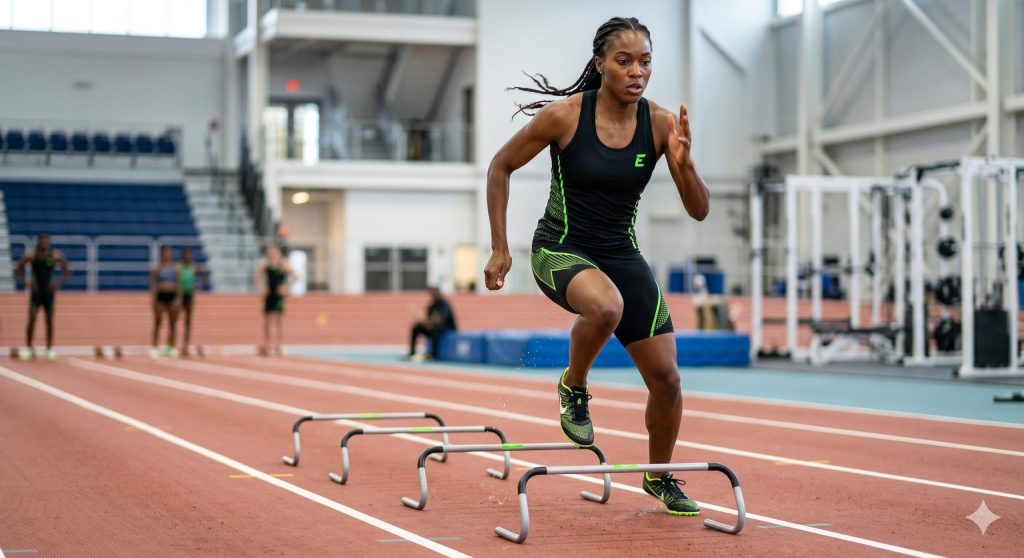
- Rhythm and Movement: Add light skips, fast feet drills, or reactive movements to the final warm-up phase. This integrates the brain and body to reinforce physical readiness.
Remember what not to do. Do not overload them with technical cues or highlight past mistakes right before execution. This only fuels the anxiety cycle.
The Role of Physical Preparation and Recovery
From a sports medicine perspective, we cannot separate the brain from the body. Poor physical recovery dramatically increases baseline anxiety. Guidelines from the National Strength and Conditioning Association (NSCA) highlight that under-fueling worsens cognitive stability, while lingering pain amplifies the brain’s threat perception.
Key physical supports must be in place. Adequate carbohydrate intake pre-event, proper hydration, and quality sleep are non-negotiable. Furthermore, proactive pain management ensures the nervous system feels safe. Exploring our comprehensive EvoFitLab services can help athletes build the robust physical foundation required to support a resilient mindset.

Conclusion
For youth coaches and parents, young athletes are especially vulnerable to overthinking and the fear of failure. Teaching them early that their job is not to calm down, but rather to focus on the immediate task, can completely change their athletic trajectory. Pre-performance anxiety in athletes is not a weakness or a lack of confidence. It is simply a brain network doing its job at the wrong time. By applying these evidence-informed strategies, you can train the brain to execute when it matters most.
Written by Gerard Nicholas, CSCS