
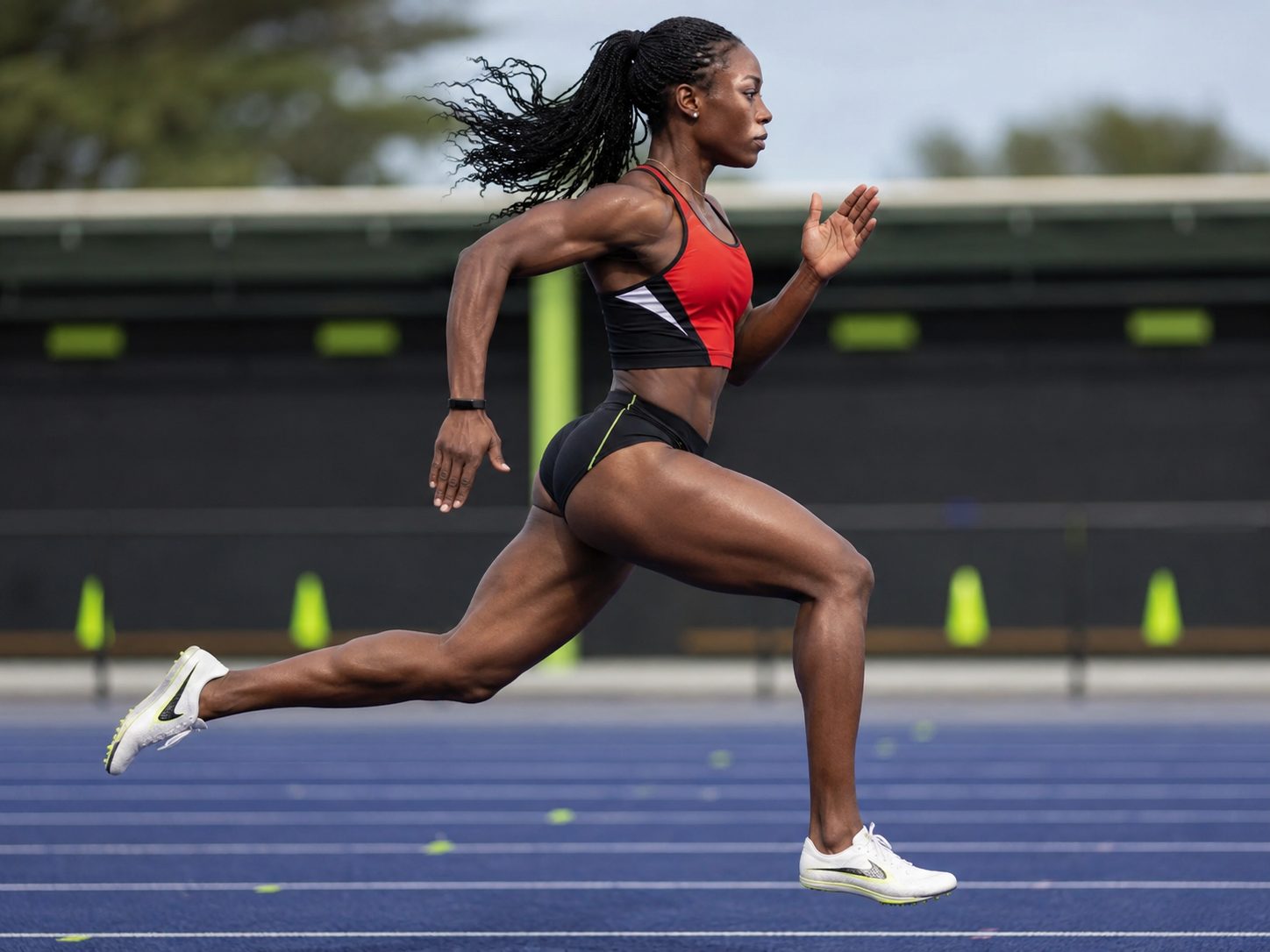
Sprinting is one of the most explosive and technically demanding movements in sport. Whether an athlete competes in track and field, football, rugby, basketball, cricket, or another field sport, the ability to accelerate and reach high velocities can dramatically influence performance.
Yet, despite decades of sports science research, sprinting remains widely misunderstood.
One of the most common misconceptions is the belief that higher knee lift is the primary driver of sprint speed. Many athletes are taught to “lift the knees higher,” as though the upward motion itself creates propulsion. Social media clips often reinforce this idea because knee lift is visually obvious and easy to identify.
However, visible movement does not always represent the true mechanical cause of performance.
Knee lift in sprinting plays an important role, but it is not the direct source of forward propulsion. To understand sprinting properly, we must first understand what actually moves the body forward.
Why Knee Lift in Sprinting Is Misunderstood
Many athletes and coaches judge sprint technique by what is easiest to see. High knees, dramatic arm action, and large stride movements stand out on video.
Still, these visible positions do not automatically create speed.
Research examining front-side mechanics and sprint performance found that visually prominent front-side positions should not be treated as the main determinant of sprint performance.
This does not mean knee lift is unimportant. Instead, it means knee lift must be understood within the complete sprint cycle.
The thigh must recover forward so the leg can prepare for the next ground contact. Therefore, knee lift supports timing, positioning, and rhythm. It does not push the athlete forward by itself.
Sprinting Is About Force Production
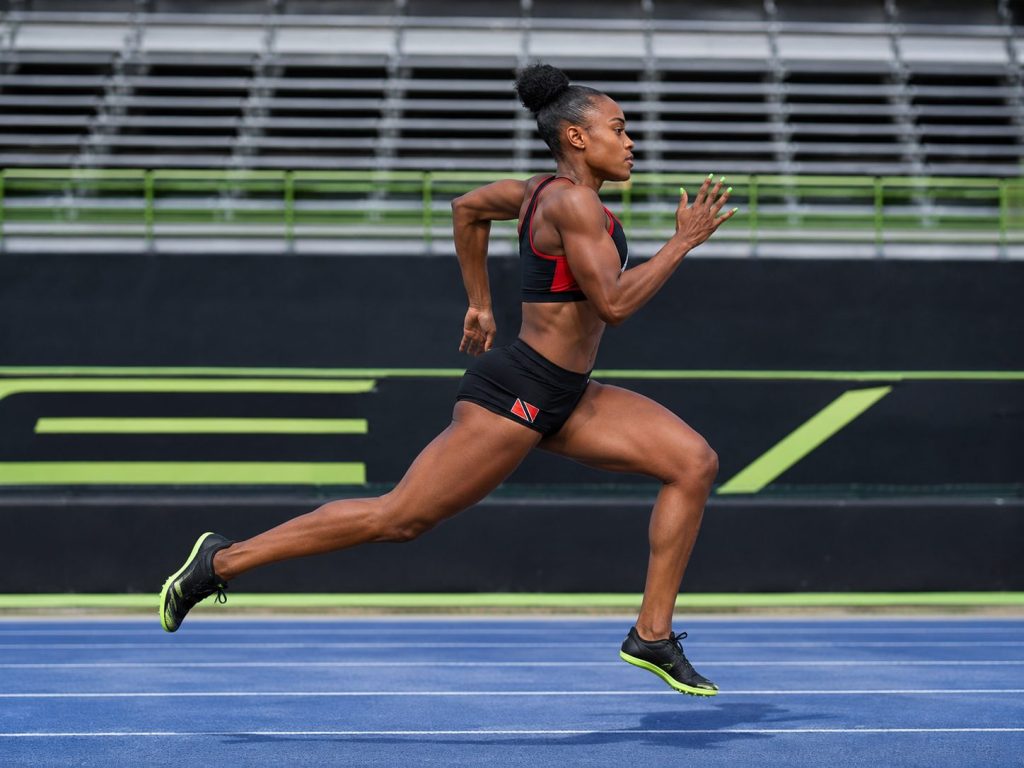
Speed is ultimately determined by how effectively an athlete applies force into the ground.
Every sprint step involves an interaction between the athlete and the surface beneath them. When the foot contacts the ground, the athlete applies force downward and backward into the track. According to Newton’s Third Law, the ground responds with an equal and opposite force called ground reaction force.
That force propels the athlete forward.
The body does not move forward because the knee rises. It moves forward because force is applied into the ground.
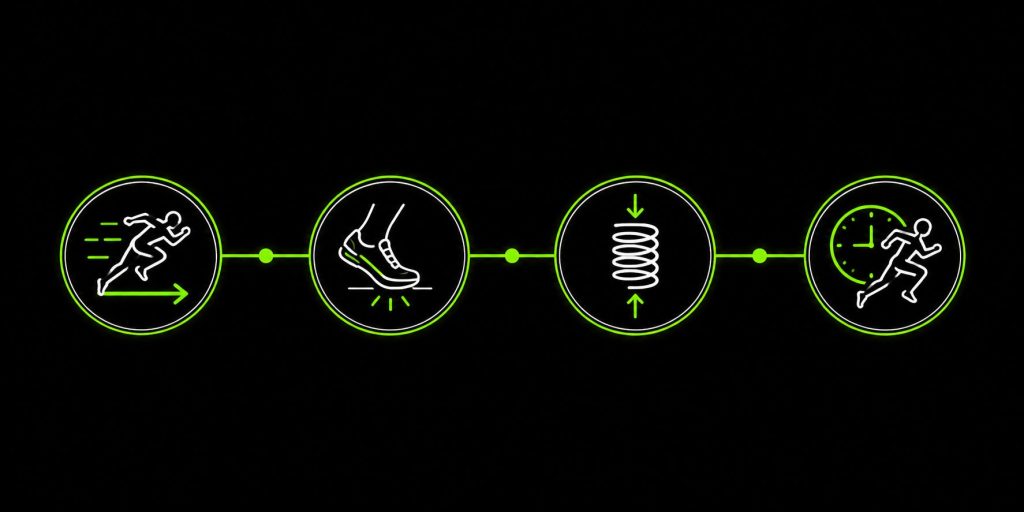
This is why sprint performance research consistently focuses on:
- Magnitude of force
- Direction of force
- Rate of force development
- Contact time
- Impulse
- Stiffness and elasticity
- Force orientation during acceleration
Research on sprint acceleration mechanics and horizontal force production highlights the importance of applying force effectively during the early stages of a sprint.
Elite sprinters are exceptional because they produce large amounts of force in very short periods of time.
At maximal velocity, ground-contact times can approach or fall below 0.10 seconds. Research on the biological limits of running speed shows why athletes must produce force rapidly during these extremely short contacts.
Therefore, athletes need the ability to:
- Produce force rapidly
- Apply force efficiently
- Maintain stiffness through the ankle, knee, and hip
- Transfer force through the kinetic chain
- Minimize braking forces
For a deeper explanation of how athletes produce force quickly, read EvoFitLab’s Rate of Force Development Training guide.
What Knee Lift Actually Does
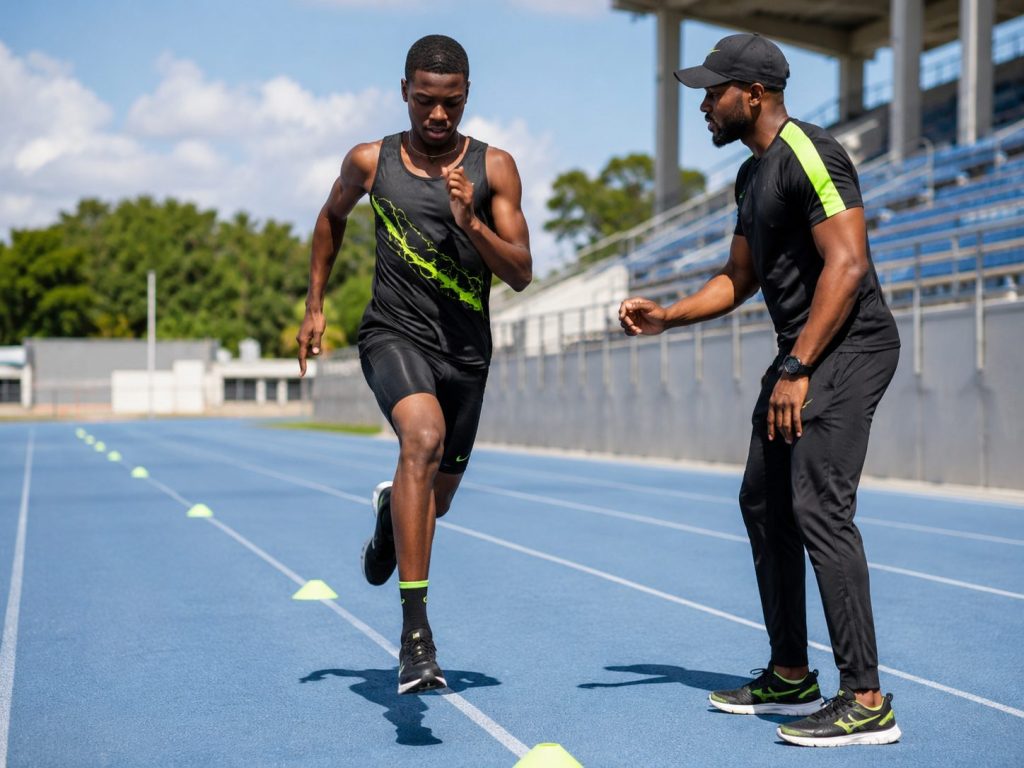
Knee lift is part of the recovery phase of sprinting.
When the thigh comes forward, the leg is repositioning itself for the next ground strike. Proper thigh recovery can help:
- Improve sprint rhythm
- Enhance stride timing
- Maintain posture
- Improve front-side mechanics
- Support step frequency
- Position the foot closer to the centre of mass
- Prepare the athlete for an efficient strike under the hips
This movement matters.
However, the purpose of the knee drive is preparation. Its purpose is not propulsion.
The athlete is organizing the body for the next force-producing action. In other words, the knee comes forward so the foot can return to the ground in an effective position.
Why Ground Contact Matters More Than Appearance
Ground contact is where speed is expressed.
Every technical component in sprinting should ultimately improve the quality of force application into the ground.
A sprinter may have beautiful knee lift, dramatic arm action, and visually impressive positions. However, if force application is poor, speed output will remain limited.
Faster athletes generally demonstrate:
- Higher relative force production
- Better horizontal force orientation during acceleration
- Shorter ground-contact times
- Greater vertical stiffness at maximal velocity
- More efficient force transfer
- Better reactive strength
- Improved tendon elasticity
The most explosive athletes are not simply moving their limbs faster. They are interacting with the ground more effectively.
This distinction is important because sprint technique should never be judged only by appearance. A movement cue is useful only when it improves timing, force application, or efficiency.
The Problem With Over-Coaching Knee Lift
Many athletes become overly focused on lifting the knee higher.
As a result, they may begin forcing the thigh upward instead of allowing it to recover naturally. This can create several technical problems:
- Overstriding
- Excessive reaching
- Increased braking forces
- Poor posture
- Loss of hip projection
- Delayed ground contact
- Longer contact times
- Reduced acceleration efficiency
In these cases, the athlete may appear technically cleaner while actually becoming slower.
This is why isolated technical cues can become harmful when they are disconnected from biomechanics and performance outcomes.
A sprint cue is only useful if it improves force application, timing, and movement efficiency.
The objective is not simply to drive the knee upward. The objective is to apply force effectively into the ground.
Coaches working on the early stages of sprinting should also review EvoFitLab’s guide to common sprint acceleration mistakes.
Acceleration and Maximal Velocity Require Different Mechanics
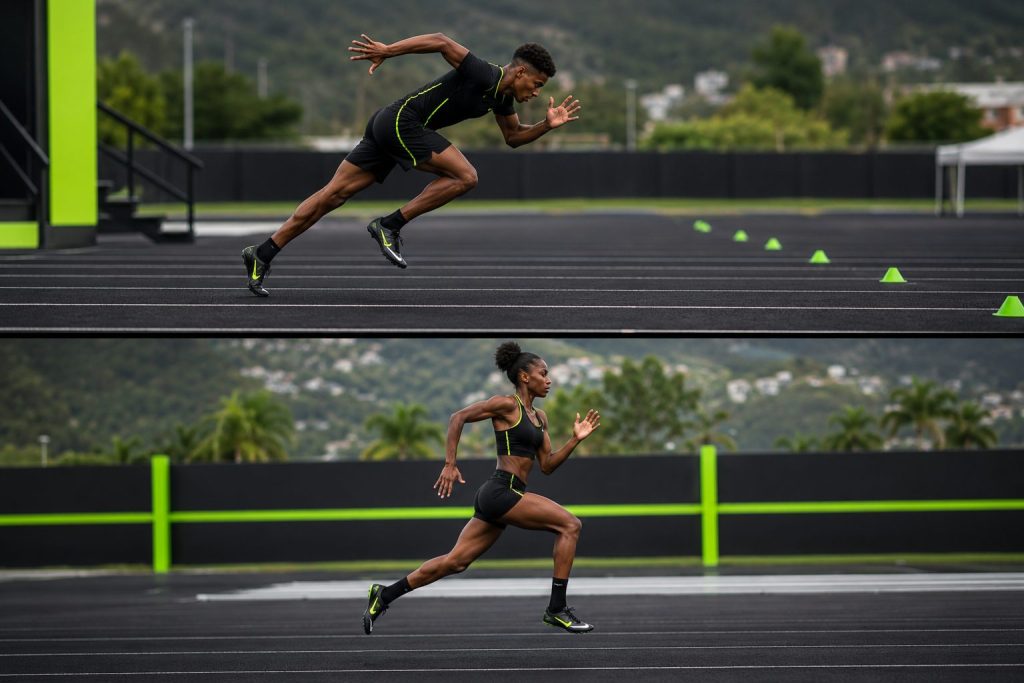
Understanding the difference between acceleration mechanics and maximal-velocity mechanics is critical.
During Acceleration
The athlete projects force more horizontally.
Key characteristics include:
- Forward body lean
- Aggressive piston-like leg action
- Longer push mechanics
- Horizontal force orientation
- Progressive rise of posture
The athlete is attempting to overcome inertia and project the centre of mass forward.
During this phase, the body should not remain low forever. Instead, posture rises progressively as speed increases.
During Maximal Velocity
Mechanics shift significantly.
Key characteristics include:
- Upright posture
- Greater vertical force emphasis
- Extremely short ground contacts
- High levels of stiffness and elastic return
- Efficient front-side mechanics
At maximal velocity, athletes are no longer pushing for long periods. They are striking rapidly and elastically.
Therefore, the knee action seen during upright sprinting should not be forced into early acceleration. Each sprint phase has a different purpose and force orientation.
Plyometrics, Eccentrics, and Sprint Transfer
True sprint development extends beyond sprint drills.
Athletes require physical qualities that support high-speed movement. This is where strength training, plyometrics, and eccentric training become essential.
Plyometric Training
Plyometrics can improve:
- Reactive strength
- Elastic energy use
- Tendon stiffness
- Rate of force development
- Neuromuscular efficiency
These qualities help athletes reduce contact times and express force more effectively.
Eccentric Strength
Eccentric training improves an athlete’s ability to:
- Absorb force
- Control landing mechanics
- Maintain stiffness
- Stabilize joints under load
- Build tissue capacity
Hamstring training is especially important for high-speed sprinting because the posterior chain must manage substantial forces as the leg prepares for ground contact.
For developing athletes, EvoFitLab’s Youth Maximum vs Explosive Strength Guide explains how foundational strength and explosive training work together.
Sprinting Is Coordination Under High Force
Sprinting is not just about strength.
It is the coordination of:
- Mobility
- Stability
- Timing
- Elasticity
- Force production
- Technical efficiency
- Neuromuscular control
All of these qualities must work together under extremely high speeds and forces.
This is why elite speed development requires more than random drills copied from social media. Athletes need structured programming that develops both the technical and physical qualities required for sprinting.
Practical Coaching Takeaways
For athletes and coaches, the major lessons are clear:
- Knee lift is important, but it is not the engine of speed.
- Ground contact is where force is expressed.
- Sprint technique should improve force application, not just visual appearance.
- Faster athletes apply force effectively in very short periods of time.
- Acceleration and maximal velocity require different force orientations.
- Plyometrics and eccentric training can improve sprint-related physical qualities.
- Speed development must combine biomechanics, strength, elasticity, coordination, and programming.
Athletes should not chase an exaggerated knee position. Instead, they should learn to organize the recovery leg, strike the ground effectively, and maintain rhythm as speed increases.
The EvoFitLab Approach
At EvoFitLab, we use evidence-informed methods to help athletes improve speed, movement quality, and athletic performance.
Our approach combines:
- Sprint mechanics
- Strength and conditioning
- Plyometric development
- Eccentric training
- Injury prevention
- Movement analysis
- Speed programming
- Sports physiotherapy
- Return-to-play progression
- Performance monitoring
Whether working with youth athletes, elite competitors, or recreational athletes, the goal remains the same:
Train intelligently. Move efficiently. Apply force effectively. Perform at your highest level.
Athletes experiencing pain, recurring hamstring problems, or difficulty tolerating high-speed running should seek an appropriate assessment before increasing sprint intensity.
Conclusion
Knee lift in sprinting is important because it helps reposition the leg, maintain rhythm, and prepare the athlete for the next ground contact.
However, it is not the real engine of speed.
Forward propulsion comes from applying force into the ground. Therefore, athletes should focus on force production, contact quality, timing, stiffness, coordination, and efficient mechanics rather than trying to lift the knee as high as possible.
To improve your speed through structured coaching, movement analysis, and performance training, explore EvoFitLab’s Athletic Development Services.
Written by Gerard Nicholas, CSCS, BSc Sports Science, Physiotherapist
EvoFitLab
LP14 Pentecostal Road, Tunapuna
Mobile: 305-5482
Email: info@evofitlab.com
Website: https://evofitlab.com