

Trunk Symmetry Assessment Guide for Fitness Professionals & Sporting Coaches
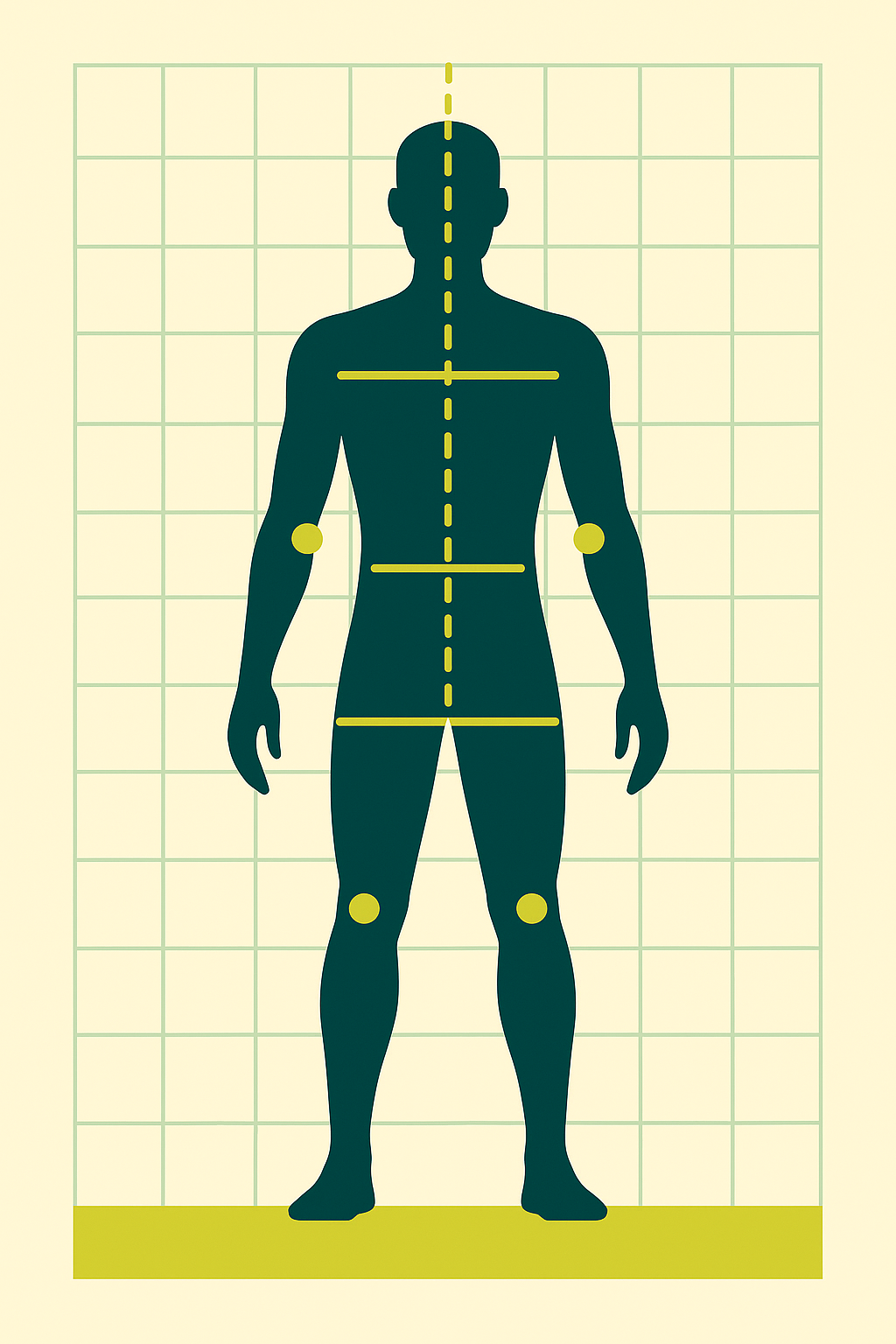
Every explosive cut, throw and sprint begins with the trunk. A precise Trunk Symmetry Assessment lets coaches quantify frontal-plane balance, spot risky asymmetries and prescribe evidence-based corrections. This guide explains the FAI, HDI and ATSI indices and shows how to fix the problems they reveal.
Why Perform a Trunk Symmetry Assessment?
Even mild alignment errors reduce force transfer and raise injury odds. Research on adolescent athletes links asymmetry > 7 ATSI points to 2× higher low-back-pain prevalence (PubMed). Screening early protects performance and careers.
Internal link: See how balanced movement underpins skill acquisition in our Four Worlds Movement Framework.
Understanding the Indices in a Trunk Symmetry Assessment
Frontal Asymmetry Index (FAI)
Measures left-right width differences at C7, axilla and waist. Ideal: ≤ 3.
Height Difference Index (HDI)
Vertical gaps at shoulder, axilla and waist. Ideal: ≤ 3; > 5 flags postural compensation.
Anterior Trunk Symmetry Index (ATSI)
FAI + HDI totals. Risk zone: ≥ 7.
Outbound link: FIFA’s medical centre outlines similar posture metrics (FIFA-MARC).
Running the Trunk Symmetry Assessment Step-by-Step
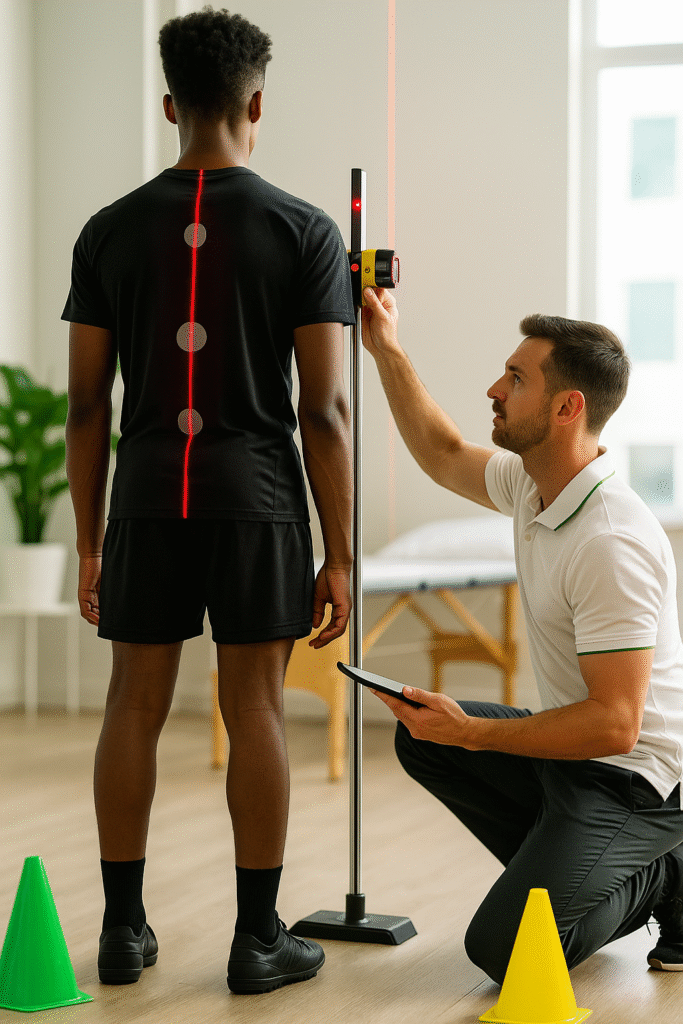
- Setup: athlete barefoot, feet hip-width, neutral stance.
- Marking: place stickers on C7, jugular notch, axillae & ASIS.
- Capture: photograph or 3-D scan from 3 m at navel height.
- Analyse: measure FAI & HDI with motion-analysis software or graph paper.
- Report: log ATSI and track change every 6–8 weeks.
Internal link: Automate data tracking with tips in our Muscle Memory Training Guide.
Corrective Strategies Following a Trunk Symmetry Assessment
- Unilateral strength: suitcase carries, single-leg RDLs (3 × 8-10).
- Anti-rotation core: Pallof press variations, half-kneel chops (3 × 12).
- Thoracic mobility: open-book rotations, foam-roll extensions.
- Scapular stability: band Ys, side-lying external rotation.
NSCA research shows unilateral training halves asymmetrical peak-force gaps in eight weeks (NSCA Journal).

Integrating Results into Programming
| ATSI Score | Risk Level | Programming Focus |
|---|---|---|
| 0–3 | Low | Normal periodisation |
| 4–6 | Moderate | Add 10 min corrective block each session |
| 7+ | High | Prioritise asymmetry drills; retest in 4 weeks |
Internal link: For sport-specific conditioning see our U15 Football Training Plan.
Conclusion – From Assessment to Athletic Advantage
A Trunk Symmetry Assessment turns vague “posture checks” into actionable numbers. Use FAI, HDI and ATSI to guide unilateral strength, anti-rotation core work and mobility drills—then watch athletes move cleaner, hit harder and stay injury-free.
Written by Gerard Nicholas, CSCS, BSc Sports Science – EvoFitLab, Tunapuna, Trinidad & Tobago